Go Unlimited with Magzter GOLD
Get unlimited access to 10,000+ magazines, newspapers and Premium stories for just
Try GOLD - Free
How Singapore's $5.1B Solidarity Budget Could Tide Over Tough Times
Singapore Business Review
|April-Jun 2020
Analysts are coining that the property, retail and financial sectors may drag Singapore’s GDP down, so the government has been ramping up its citizen’s spending power.
-

Following the $48.4b Resilience Budget on 26 March and the $6.4b Unity Budget in February, Deputy Prime Minister and Finance Minister Heng Swee Keat announced the Solidarity Budget of $5.1b. This brings the total stimulus to $59.9b, which is about 12% of Singapore’s GDP, according to OCBC Investment Research (OIR).
With the latest measures, the overall budget deficit for FY2020 will increase to $44.3b or 8.9% of GDP. To get a sense of how significant this is, in FY19, Singapore saw a deficit of $1.7b, which was just 0.3% of GDP.
To further support the country during the four weeks when the circuit breaker measures are in place, the Solidarity Budget aims to save jobs, and protect the livelihoods of people during this temporary period of heightened measures.
There will also be help for businesses to preserve their capacity and capabilities, to resume activities when the circuit breaker is lifted. In addition, there will be direct cash in hand for households, to help tide families through this difficult period. Should the circuit breaker be extended beyond four weeks, we believe there could be a possibility for further measures.
All in, the measures that the Singapore government is taking would be a supportive factor for the domestic equity market, and this latest Solidarity Budget is meant to tide the country over these four weeks. Should the circuit breaker last longer than expected, further measures may be required.
Helping where it hurts most
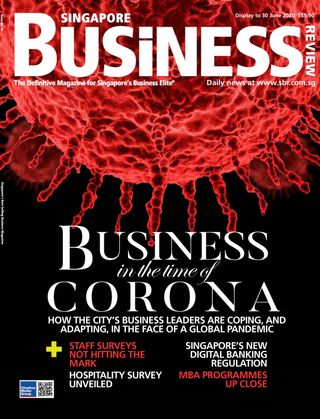

This story is from the April-Jun 2020 edition of Singapore Business Review.
Subscribe to Magzter GOLD to access thousands of curated premium stories, and 10,000+ magazines and newspapers.
Already a subscriber? Sign In
MORE STORIES FROM Singapore Business Review

Singapore Business Review
No green light for Grab: Is it time to lift the cross-border ride-hailing ban?
Analysts backed Singapore’s decision to keep a ban on cross-border private ride-hailing service with Johor Bahru, Malaysia, citing adequate options and potential risks to the local taxi industry.

3 mins
Issue 113

Singapore Business Review
LAW FIRMS SEE SURGE IN GREEN WORK
Law firms are seeing a surge in client demand for sustainability-related advice as companies scramble to comply with tighter environmental, social, and governance (ESG) requirements.
1 min
Issue 113

Singapore Business Review
REDEFINING EXPERIENCES THROUGH HUMAN-CENTRIC TECHNOLOGY
Co-creating Singapore's first 'Borderless University' with StarHub's Ubiquitous Network.
2 mins
Issue 113
Singapore Business Review
Notable architecture professionals under 40
In search of the best architecture professionals under 40, Singapore than 25 architecture firms in the city-state.
8 mins
Issue 113

Singapore Business Review
Government tightens rules on quick flips
A revision to Singapore's seller's stamp duty (SSD) rules that extends the minimum holding period for residential properties from three to four years is expected to dissuade short-term investors and complicate exit strategies for some buyers, analysts said.
2 mins
Issue 113
Singapore Business Review
How B2B insurance is changing in Singapore
When it comes to innovation in financial services, Singapore often punches well above its weight.
3 mins
Issue 113

Singapore Business Review
Mandatory insurance may boost SME trust in small audit firms
Minimum coverage starts at $1m, rising with the size of the firm up to $50m.
2 mins
Issue 113
Singapore Business Review
Department stores shrink, add dining and wellness
Social media and e-commerce are raising shopper expectations.
2 mins
Issue 113

Singapore Business Review
SG, India launch green shipping corridor
The digital side of the deal could improve port operations.
2 mins
Issue 113
Singapore Business Review
Property owners shift to mixed-use designs
Clients want buildings that are integrated and human-centric.
2 mins
Issue 113
Translate
Change font size