Denemek ALTIN - Özgür
Making It In The Gig Economy
Kiplinger's Personal Finance
|July 2019
Whether you’re earning extra money or working full time, you’ll need to adopt new financial strategies.

Dan Simms spent decades working in sales, but after more job-hopping than he preferred, he was ready for a career change. A friend suggested DogVacay, a service that linked up pet owners with people who could walk or care for their animals while they were at work or away. (DogVacay was acquired by Rover, a similar service, in 2017.) Simms and his wife, Denise, had owned dogs for more than 30 years, and their Long Island, N.Y., house and large yard were ready-made for a new crew of canines.
In late 2016, Simms set up a profile on the website, printed a stack of business cards and pitched his services to veterinarians and travel agents, figuring they might be a good source of clients. Now, he regularly pulls in more than $5,000 each month after paying estimated taxes and oversees an average of five dogs during the week and eight over the weekend. To keep both his human and non-human clients happy, he sends short videos of each dog to its owner during its stay. He even makes house calls to care for aggressive or injured dogs as needed. Although Simms works seven days a week, “it’s a labor of love,” he says. “I see myself doing this for another 12 to 15 years.”
NEW TWIST ON AN OLD IDEA
Freelance and independent contract work is nothing new, but the apps and websites that power the gig economy have brought on-demand employment into the mainstream. “The gig economy crosses all sectors, incomes and education levels,” says Diane Mulcahy, author of The Gig Economy (HarperCollins). “It has infiltrated professions that were dominated by full-time work.” For example, you can consult as a lawyer, flex your admin skills as a virtual assistant, share your hometown with tourists as a private guide or cook up a feast for paying guests—all on your own time and schedule (see page 30 for a list of promising side hustles).
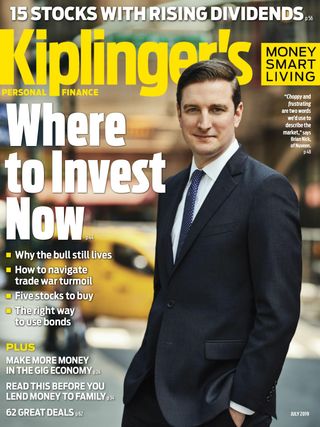

Bu hikaye Kiplinger's Personal Finance dergisinin July 2019 baskısından alınmıştır.
Binlerce özenle seçilmiş premium hikayeye ve 9.000'den fazla dergi ve gazeteye erişmek için Magzter GOLD'a abone olun.
Zaten abone misiniz? Oturum aç
Kiplinger's Personal Finance'den DAHA FAZLA HİKAYE

Kiplinger's Personal Finance
A TAX BREAK FOR MEDICAL EXPENSES
The editor of The Kiplinger Tax Letter responds to readers asking about health care write-offs.

2 mins
February 2026

Kiplinger's Personal Finance
Volunteering to Help Others at Tax Time
Through an IRS program, qualifying individuals can get free assistance with their tax returns.
2 mins
February 2026

Kiplinger's Personal Finance
CATCH-UP SAVERS FACE A TAXING 401(K) CHANGE
Under new rules, you may lose an up-front deduction but gain tax-free income once you retire.
2 mins
February 2026

Kiplinger's Personal Finance
The Case for Emerging Markets
Economic growth, earnings acceleration and bargain prices favor EM stocks.
3 mins
February 2026

Kiplinger's Personal Finance
THE NEW RULES OF RETIREMENT
Popular guidelines about how to save, invest and spend need to be updated and personalized to ensure you'll never run out of money.
15 mins
February 2026

Kiplinger's Personal Finance
Smart Ways to Share a Credit Card
Adding an authorized user has its benefits, but make sure you set the ground rules.
2 mins
February 2026

Kiplinger's Personal Finance
THE BEST AFFORDABLE FITNESS TRACKERS
These devices monitor your exercise, sleep patterns and more- and they don't cost an arm and a leg.
4 mins
February 2026
Kiplinger's Personal Finance
A VALUE FOCUS CLIPS RETURNS
THERE'S more to Mairs & Power Growth than its name implies. The managers favor firms with above-average earnings growth. But a durable, competitive position in their market- “a number-one or number-two position and gaining share,” says comanager Andrew Adams—and a reasonable stock price matter even more.
1 mins
February 2026

Kiplinger's Personal Finance
Look Beyond the Tech Giants
I am hooked on a podcast called Acquired, in which two smart guys do a deep analytical dive, typically lasting three or four hours, on a single successful company such as Coca-Cola or Trader Joe's. Ben Gilbert and David Rosenthal, a pair of venture capitalists, are especially adept at explaining what's behind the success of such tech giants as Alphabet (symbol GOOGL, $320), the former Google, which recently merited 11 hours and 42 minutes of dialogue all by itself.
4 mins
February 2026

Kiplinger's Personal Finance
How to Pay for Long-Term Care
A couple of months ago, I wrote that many Americans significantly underestimate how long they could live in retirement (see “Living in Retirement,” Dec.). With the possibility of a 30-year retirement becoming more common, retirees need to plan for so-called longevity risk to make sure their assets last a lifetime. And the longer you live, the more likely you'll need to pay for some form of long-term care. That can range from assistance with activities of daily living to in-home care to a nursing home stay.
2 mins
February 2026
Translate
Change font size