Denemek ALTIN - Özgür
HOW TO MAKE THE MOON ON EARTH
BBC Science Focus
|November 2023
The expense and prestige involved in sending landers and rovers to the Moon means you can’t afford for them not to work when they get there. But the lunar landscape is like nothing here on Earth. So how, and where, do you test equipment that’s bound for the Moon?

Nighttime in the Mojave Desert. The stars of the Milky Way turn slowly above a landscape so dark you can barely make it out. Suddenly, spotlights switch on. They're angled low to the horizon and off to one side, but spill light across a pale grey, undulating terrain that's pockmarked by craters. You know you're standing among the sands of California, but lit like this, it looks like you're on the Moon.
This 'Moon in the Mojave' is the work of spaceflight company Astrobotic, which has been building the Lunar Surface Proving Ground (LSPG). The 100m² (approx 1,000ft²) site has been made to look exactly like the lunar south pole. The region was ignored by early Moon explorers, but has witnessed a surge in interest over the last decade after signs of water ice were found in the permanently shadowed recesses of deep craters. Such water could be an invaluable resource both for science and future explorers.
Astrobotic aims to head to the region with its Peregrine and Griffin landers, due to launch this December and then November 2024 respectively. They're just two of a great many missions supporting NASA's Artemis programme to return humans, including the first woman and person of colour, to the lunar surface by the end of the decade. But before either Peregrine or Griffin can even think of leaving the ground, they have to be fully tested.
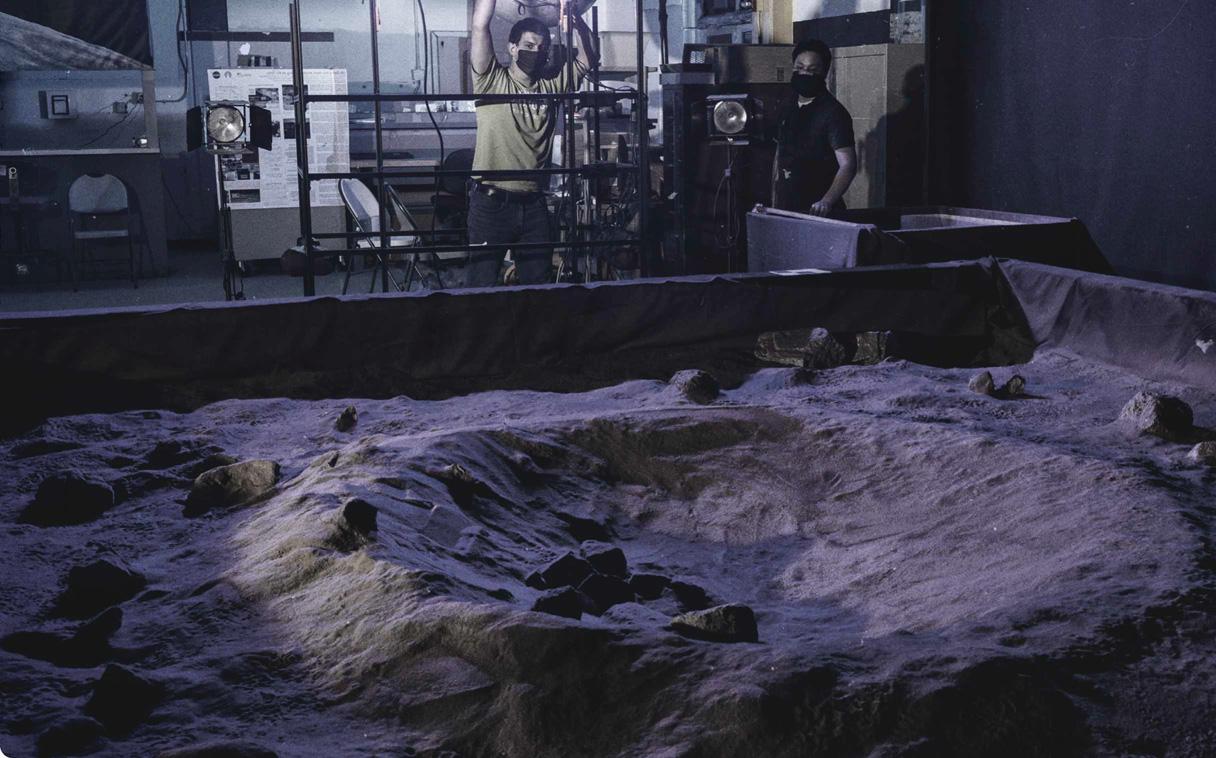
MIMICKING THE MOON


Bu hikaye BBC Science Focus dergisinin November 2023 baskısından alınmıştır.
Binlerce özenle seçilmiş premium hikayeye ve 9.000'den fazla dergi ve gazeteye erişmek için Magzter GOLD'a abone olun.
Zaten abone misiniz? Oturum aç
BBC Science Focus'den DAHA FAZLA HİKAYE

BBC Science Focus
ARE PSYCHOPATHS REALLY THAT GOOD AT LYING?
Picture infamous psychopaths from fiction, such as the eerily cold and calculating Patrick Bateman in the film adaptation of American Psycho, and they certainly seem like master deceivers. But what about real-life psychopaths? Research confirms that psychopaths are more inclined to lie to get what they want, and that they typically display a striking fearlessness - as if they have ice running through their veins.

1 min
January 2026
BBC Science Focus
WHY DO WE HAVE TWO OF SOME ORGANS, BUT ONLY ONE OF OTHERS?
The majority of animals on Earth, humans included, are bilaterally symmetrical. It means we can be divided roughly into two mirror-image sides. Evolutionary biologists believe that it has been like that for at least 300 million years, and because life organised this way survived, so did symmetrical design. Hence, two eyes, two ears, two lungs and two kidneys.
1 min
January 2026

BBC Science Focus
WHY DO CATS PREFER TO SLEEP ON THEIR LEFT?
I've said it before, and I'll keep saying it again and again and again: who knows why cats do anything?
1 min
January 2026

BBC Science Focus
FORGET COUNTING CALORIES TRY THIS INSTEAD...
Calorie counting isn't just difficult, it's riddled with problems that make it practically useless for anyone trying to lose weight.But there are alternatives
9 mins
January 2026

BBC Science Focus
SIGNS OF LIFE
The more planets we find outside our Solar System, the better our chances are of finding life on one of them. But if there really is life out there, how do we spot it?
8 mins
January 2026
BBC Science Focus
WHAT ACTUALLY MAKES SOMEBODY COOL?
Most of us have probably wanted to be cool at some point in our lives, and these efforts can have a big influence on the things we buy, the way we dress, the hobbies we invest in, the people we look up to and even the words we use.
2 mins
January 2026

BBC Science Focus
It's TIME to WAKE UP and SMELL the roses
What if the pursuit of happiness in the traditional sense – chasing wealth or power – is the very thing stopping you from being happy? Researchers are beginning to understand that spending time enjoying the simple things might be the secret ingredient to enjoying a happy, healthy life
8 mins
January 2026

BBC Science Focus
THE AARDVARK
In a time when people are being asked to consider eating insects, we should, perhaps, learn a thing or two from the aardvark (Orycteropus afer), Africa’s ant-guzzling gourmand. On an average night, the big-schnozzed mammal devours up to 50,000 of the crunchy critters.
2 mins
January 2026

BBC Science Focus
ADD WEIGHT TO LOSE WEIGHT
A very basic kind of wearable could make your New-Year-weight-loss plans stick
3 mins
January 2026

BBC Science Focus
AHEAD OF THEIR TIME
The Maya civilisation is known for its art and architecture.
8 mins
January 2026
Translate
Change font size