
Magzter GOLD ile Sınırsız Olun
Sadece 9.000'den fazla dergi, gazete ve Premium hikayeye sınırsız erişim elde edin
Denemek ALTIN - Özgür
NLP: Text Summarisation with Python
Open Source For You
|March 2025
Here's a simple Python method based on the Natural Language Toolkit for extractive text summarisation in natural language processing.

In natural language processing (NLP), frequency-based summarisation is a straightforward extractive text summarisation technique that selects sentences based on the frequency of important words in the text. The approach is based on the assumption that frequently occurring words represent the core themes of the text. Let's discuss a simplified algorithm using this approach.
Steps in frequency-based summarisation Preprocessing:
- Tokenization: Split the text into sentences and words.
- Stop word removal: Remove common words like 'and', 'the', or 'is' that do not contribute to meaning.
- Stemming: Reduce words to their base forms.
Word frequency calculation:
- Count the occurrences of each word in the text.
- Normalise frequencies if needed, e.g., by dividing by the total number of words.
Sentence scoring:
- Assign scores to sentences based on the cumulative frequency of the words they contain.
- Sentences with more frequent words score higher.
Sentence selection:
- Rank sentences by their scores.
- Select the top n sentences (based on a predefined ratio or word count) to form the summary.
Natural Language Toolkit (NLTK) package-based text processing uses this package with all the required modules. The following modules have been used here.
from nltk.corpus import stopwords
from nltk.tokenize import word_tokenize, sent_tokenize
from nltk.stem import PorterStemmer
Tokenization
In natural language processing, tokenization divides a string into a list of tokens. Tokens are useful when finding valuable patterns; tokenization also replaces sensitive data components with non-sensitive ones.
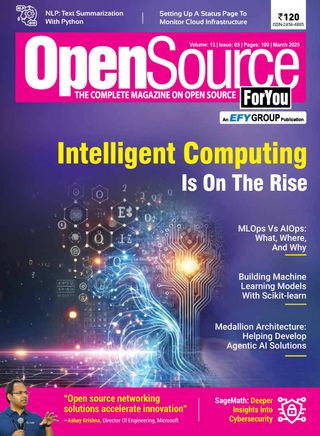

Bu hikaye Open Source For You dergisinin March 2025 baskısından alınmıştır.
Binlerce özenle seçilmiş premium hikayeye ve 9.000'den fazla dergi ve gazeteye erişmek için Magzter GOLD'a abone olun.
Zaten abone misiniz? Oturum aç
Open Source For You'den DAHA FAZLA HİKAYE

Open Source For You
Ukraine builds sovereign AI using Google's Gemma
Ukraine has launched a landmark national AI initiative, building a fully sovereign large language model (LLM) using Google's open source Gemma framework.

1 min
January 2026

Open Source For You
Kubernetes vs Docker Swarm: Choosing the Right Orchestration Tool
This overview of the differences between Kubernetes and Docker Swarm will help DevOps developers determine the right container orchestration tool for their project.
5 mins
January 2026

Open Source For You
Quantum Programming: Speaking the Language of Qubits
Quantum software tools are evolving and will soon make quantum computing easily accessible. With tools like Qiskit and Cirq, anyone can begin exploring the quantum world, experiment with algorithms, and contribute to a rapidly evolving field.
7 mins
January 2026

Open Source For You
Building a Real-Time Grocery Price Comparison System
This real-time grocery price comparison system has been designed for leading Indian e-commerce platforms. Built on microservices architecture, the system leverages FastAPI for backend services and Selenium for dynamic web scraping to deliver accurate, up-to-date pricing data.
7 mins
January 2026
Open Source For You
The Role of Generative AI in the AWS Database Migration Service
The integration of generative AI in the AWS Database Migration Service enhances schema conversion, making data migrations more accurate, speedy, and efficient.
7 mins
January 2026

Open Source For You
Proxmox unveils open source Datacenter Manager
Proxmox has officially launched the first full and stable version of its Datacenter Manager, positioning itself as a robust open source alternative for private cloud deployments.
1 min
January 2026
Open Source For You
Linux Foundation lauds Japan's OSS boom but warns of governance and security gaps
Linux Foundation Research has released its latest report, ‘The State of Open Source Japan 2025: Accelerating Business Value through Strategic Open Source Engagement’.
1 min
January 2026

Open Source For You
Improving Microservices Performance with Django
Django, along with other open source tools like Redis, PostgreSQL, Celery and NGINX, helps address the challenges of request overhead and latency in microservices architecture.
4 mins
January 2026

Open Source For You
Manim: Creating Dynamic Visual Animations
Learn about how Manim, a Python library, converts code into captivating animations, and why it has become the preferred choice for educators, developers, and content creators worldwide.
4 mins
January 2026

Open Source For You
openSUSE empowers Linux developers with Intel NPU access
The openSUSE project has begun distributing packaging for the Intel Neural Processing Unit (NPU) driver, enabling small-scale AI development on Linux.
1 min
January 2026
Listen
Translate
Change font size