يحاول ذهب - حر
Mill, Free Speech & Social Media
August/September 2022
|Philosophy Now
Nevin Chellappah asks whether John Stuart Mill's famous account of free speech is still sustainable in the age of Twitter.

It is arguably the paramount value in liberal democracies and the foundation of our other liberties. The fervent endorsement of free speech by so many today can be traced back to John Stuart Mill's reasoning in Chapter 2 of his essay On Liberty (1859). Mill made a powerful argument for allowing free speech because, he said, it is essential in the search for truth. Yet, whilst Mill had a clear conception of the end benefits of free speech, many of its modern defenders tend by contrast to see it as a prima facie good: something that should be allowed except where there is a particular reason not to. The implication is that free speech has an inherent value, not just an instrumental one, and this suggests a fundamental shift in how we understand it. Hence, in this article I will argue that the classical liberal version of free speech espoused by Mill is no longer compatible with the digital age, especially for social media.
Mill's Argument for Free Speech
First, let me set out Mill's account of free speech. His first concern in On Liberty is with the suppression of opinions by an authority. For him:
"The peculiar evil of silencing the expression of an opinion is that it is robbing the human race; posterity as well as the existing generation; those who dissent from the opinion, still more than those who hold it. If the opinion is right, they are deprived of the opportunity of exchanging error for truth: if wrong, they lose, what is almost as great a benefit, the clearer perception and livelier impression of truth, produced by its collision with error."
In response to censorship being presented as a trusted system to filter out true expressions from false ones, Mill says that there is no perfect censor. This is demonstrated by history, with past ages suppressing ideas that are now accepted to be true (the
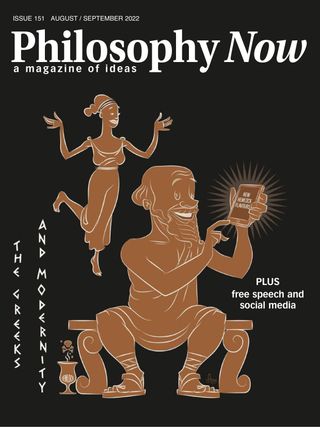

هذه القصة من طبعة August/September 2022 من Philosophy Now.
اشترك في Magzter GOLD للوصول إلى آلاف القصص المتميزة المنسقة، وأكثر من 9000 مجلة وصحيفة.
هل أنت مشترك بالفعل؟ تسجيل الدخول
المزيد من القصص من Philosophy Now
Philosophy Now
Bilbo Theorizes About Wellbeing
Eric Comerford overhears Bilbo and Gandalf discussing happiness.

9 mins
December 2025 / January 2026

Philosophy Now
What Women?
Marcia Yudkin remembers almost choking at Cornell
11 mins
December 2025 / January 2026
Philosophy Now
Islamic Philosophers On Tyranny
Amir Ali Maleki looks at tyranny from an Islamic perspective.
4 mins
December 2025 / January 2026

Philosophy Now
Peter Singer
The controversial Australian philosopher defends the right to choose to die on utilitarian grounds
5 mins
December 2025 / January 2026

Philosophy Now
Another Conversation with Martin Heidegger?
Raymond Tallis talks about communication problems.
7 mins
December 2025 / January 2026

Philosophy Now
Letters
When inspiration strikes, don't bottle it up. Email me at rick.lewis@philosophynow.org Keep them short and keep them coming!
17 mins
December 2025 / January 2026
Philosophy Now
The Philosophy of William Blake
Mark Vernon looks at the imaginative thinking of an imaginative artist.
9 mins
December 2025 / January 2026

Philosophy Now
Philosophical Haiku
Peering through life’s lens God in nature is deduced: The joy of being.
1 mins
December 2025 / January 2026

Philosophy Now
Philosophy Shorts
More songs about Buildings and Food' was the title of a 1978 album by the rock band Talking Heads. It was about all the things rock stars normally don't sing about. Pop songs are usually about variations on the theme of love; tracks like Rose Royce's 1976 hit 'Car Wash' are the exception. Philosophers, likewise, tend to have a narrow focus on epistemology, metaphysics and trifles like the meaning of life. But occasionally great minds stray from their turf and write about other matters, for example buildings (Martin Heidegger), food (Hobbes), tomato juice (Robert Nozick), and the weather (Lucretius and Aristotle). This series of Shorts is about these unfamiliar themes; about the things philosophers also write about.
2 mins
December 2025 / January 2026
Philosophy Now
Hedonic Treadmills in the Vale of Tears
Michael Gracey looks at how philosophers have pursued happiness.
8 mins
December 2025 / January 2026
Translate
Change font size