
Mit Magzter GOLD unbegrenztes Potenzial nutzen
Erhalten Sie unbegrenzten Zugriff auf über 9.000 Zeitschriften, Zeitungen und Premium-Artikel für nur
Versuchen GOLD - Frei
The Meaning of Death
Philosophy Now
|August/September 2020
Laszlo Makay, George Marosan Jr. and David Vatai consider whether death destroys meaning or creates it.

Unsurprisingly, people are obsessed with the meaning of their lives. Many also think that death is the antithesis of meaning – the single greatest obstacle to a meaningful life. However, what if this is a misunderstanding? Moreover, if we discovered the meaning of death (if any exists), would it cast light on the meaning of life?
All of us have heard things like “Everyone dies, so life is meaningless.” Or taking this logic to a higher level, someone may say: “The unavoidable destruction of the universe – via heat death, the big crunch, or the big rip, you name it – makes the existence of the entire human race meaningless.” These simple reasonings seem correct. Our own deepest fears only serve to help them appear realistic.
Things have meaning because they are meaningful to somebody. Once that person dies then nothing matters to them anymore, so surely the things in their life that had meaning no longer do? Hasty conclusions are usually misleading, and in this case, the conclusions are incorrect. Some meanings or their bearers can survive our own individual deaths – such as our own children or our contribution to society. Many external goals and achievements may continue to exist after our death. And in some special cases – for example, sacrificing oneself for a noble cause – death may even be necessary to fully realise a meaningful individual life.
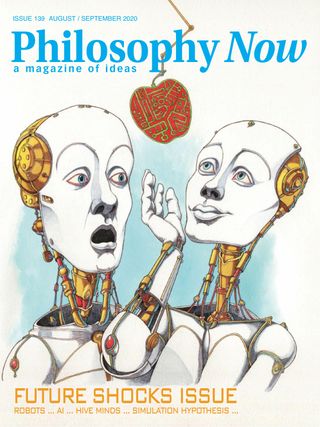

Diese Geschichte stammt aus der August/September 2020-Ausgabe von Philosophy Now.
Abonnieren Sie Magzter GOLD, um auf Tausende kuratierter Premium-Geschichten und über 9.000 Zeitschriften und Zeitungen zuzugreifen.
Sie sind bereits Abonnent? Anmelden
WEITERE GESCHICHTEN VON Philosophy Now

Philosophy Now
Nosferatu
Stefan Bolea considers two very different artistic approaches to love and death.

6 mins
April/May 2025

Philosophy Now
Heidegger's Ghost
Raymond Tallis wonders where Heidegger's body went when he was philosophising.
7 mins
April/May 2025

Philosophy Now
Is Comedy Good For Us?
Damaris Stock has a laugh with Plato and friends.
10 mins
April/May 2025
Philosophy Now
In Defense of Idleness
Wendell O'Brien says, 'Just Don't Do It'.
10 mins
April/May 2025
Philosophy Now
Leaving Nothing to Chance by Carl Knight
LEAVING NOTHING TO Chance (2025) by Carl Knight, is an informed, proficient and lucid defence of luck egalitarianism.
3 mins
April/May 2025

Philosophy Now
Star Maker by Olaf Stapledon
THE 1937 SCIENCE FICTION novel Star Maker was written by philosophy professor Olaf Stapledon in the dark days as Europe awaited the onslaught of Nazi Germany. This casts a shadow over the whole book.
6 mins
April/May 2025
Philosophy Now
Love & Emptiness in the Sufi Tradition
Medha Ninad Tambe meditates on Rumi, love and self-negation.
7 mins
April/May 2025

Philosophy Now
The Hedgehog's Dilemma: A Metaphor About the Challenges of Human Intimacy
Krishna Chaubey explains Arthur Schopenhauer's poignant thought experiment.
4 mins
April/May 2025
Philosophy Now
The Mirror & the Flame
Rebwar Fatah imagines Attar's & Hegel's shared path.
4 mins
April/May 2025
Philosophy Now
Free and Equal by Daniel Chandler
DANIEL CHANDLER, AN economist and philosopher based at the London School of Economics, begins Free and Equal: What Would a Fair Society Look Like? (2023) by asking an intriguing question. How is it, he wonders, that the most influential political philosopher of the last century has had almost no practical impact on politics or policy? The philosopher in question is John Rawls, whose magnum opus was A Theory of Justice (1971).
5 mins
April/May 2025
Translate
Change font size