
Mit Magzter GOLD unbegrenztes Potenzial nutzen
Erhalten Sie unbegrenzten Zugriff auf über 9.000 Zeitschriften, Zeitungen und Premium-Artikel für nur
Versuchen GOLD - Frei
The Four Guardrails That Enable Agility
MIT Sloan Management Review
|Fall 2024
Large organizations can move as fast as startups if leaders empower employees to act autonomously via well-defined constraints.

WHAT DOES IT TAKE FOR A LARGE, established business to be as responsive to changing market conditions as the startups in its industry are? That question is a vital one for leaders seeking to move nimbly to address new customer demands and competitive shifts.
The answer often lies in a single word: empowerment. Startups typically empower their teams to make quick decisions, take risks, and explore novel ideas. These nimble teams operate with a level of autonomy that enables them to rapidly sense and seize opportunities that arise from changes in technologies, competition, and customer needs. In doing so, they iteratively move toward achieving their strategic objectives.
But for large organizations, adopting these practices isn't quite as simple. With scale and complexity come layers of decision-making, risk aversion, and the need for operational efficiency and strategic alignment across diverse business units. So while greater empowerment is necessary to drive organizational agility, it also needs to be rooted in a level of coordination that keeps the organization moving cohesively toward its strategic objectives.
This is the challenge I'd like to address in this article: How can large organizations foster empowerment in a way that maintains organizational coherence and strategic alignment? I have studied this question for the past five years and found that what's most required are four decision rights guardrails that define constraints around an organization's purpose, data, policies, and allocation of resources. Like the barriers on a highway, these guardrails provide a zone within which employees can act autonomously, enabling their organizations to operate faster, reduce risk, and keep teams headed in the right direction.
Ultimately, my research suggests that these guardrails give large, established organizations the potential to be just as agile - if not more so than their startup counterparts.
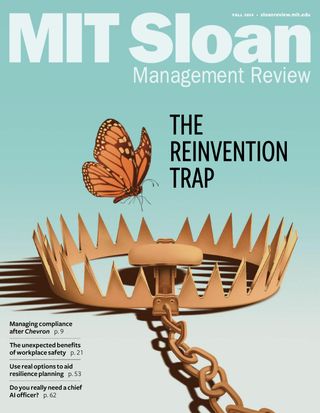

Diese Geschichte stammt aus der Fall 2024-Ausgabe von MIT Sloan Management Review.
Abonnieren Sie Magzter GOLD, um auf Tausende kuratierter Premium-Geschichten und über 9.000 Zeitschriften und Zeitungen zuzugreifen.
Sie sind bereits Abonnent? Anmelden
WEITERE GESCHICHTEN VON MIT Sloan Management Review

MIT Sloan Management Review
Assess What Is Certain in a Sea of Unknowns
Understanding what won't change clarifies what might — and strengthens decision-making in volatile times.

13 mins
winter 2026

MIT Sloan Management Review
Ask Sanyin: Why Is It So Hard to Pull the Plug on a Project?
We're finding it difficult to wind down projects that no longer serve our priorities.
2 mins
winter 2026

MIT Sloan Management Review
Integrate Sustainability and Innovation to Find New Opportunities
Five common innovation practices can help leaders pursue sustainability as a growth strategy.
12 mins
winter 2026

MIT Sloan Management Review
The Case for Quiet Corporate Activism
Leaders concerned that they will be penalized for championing sustainability and diversity can still sustain their commitments.
11 mins
winter 2026

MIT Sloan Management Review
The Perils of Algorithmic Pricing
Some revenue management systems based on algorithms may lead to unintended collusion and antitrust violations.
9 mins
winter 2026

MIT Sloan Management Review
Broadening Future Perspectives at the Bank of England
Leaders at the U.K’s central bank sought to broaden their thinking about future risks and opportunities. Here’s how they built longer-term horizon-scanning capabilities and what they learned along the way.
9 mins
winter 2026

MIT Sloan Management Review
How Nesting Changes Platform Strategy
Should your platform host another platform — or be hosted by one? Here's how to think through the choices.
14 mins
winter 2026
MIT Sloan Management Review
Are You an Authentic Leader or an Authentic Jerk?
Leaders who are true to their values can inspire trust and respect, but not if \"being yourself\" becomes the problem.
13 mins
winter 2026

MIT Sloan Management Review
How to Make Scenario Planning Stick
Developing future scenarios can deepen leaders’ strategic insights. Establishing scenario planning as an ongoing capability and reaping its full benefits require linking it to other processes.
16 mins
winter 2026

MIT Sloan Management Review
A Faster Way to Build Future Scenarios
This streamlined approach to scenario planning incorporates AI and helps managers navigate future uncertainties more efficiently.
13 mins
winter 2026
Listen
Translate
Change font size