
Mit Magzter GOLD unbegrenztes Potenzial nutzen
Erhalten Sie unbegrenzten Zugriff auf über 9.000 Zeitschriften, Zeitungen und Premium-Artikel für nur
Versuchen GOLD - Frei
Thin Film Transistor LED Displays - Visual I/O
Circuit Cellar
|September 2024
To add a resistive touchscreen on top of a TFT display, Jeff explores the technology offerings and libraries needed to accomplish his task. Calibrating the touchscreen's computed coordinates with the actual pixel coordinates of the display proved difficult with a modular framework but separating functions allows easy expansion.
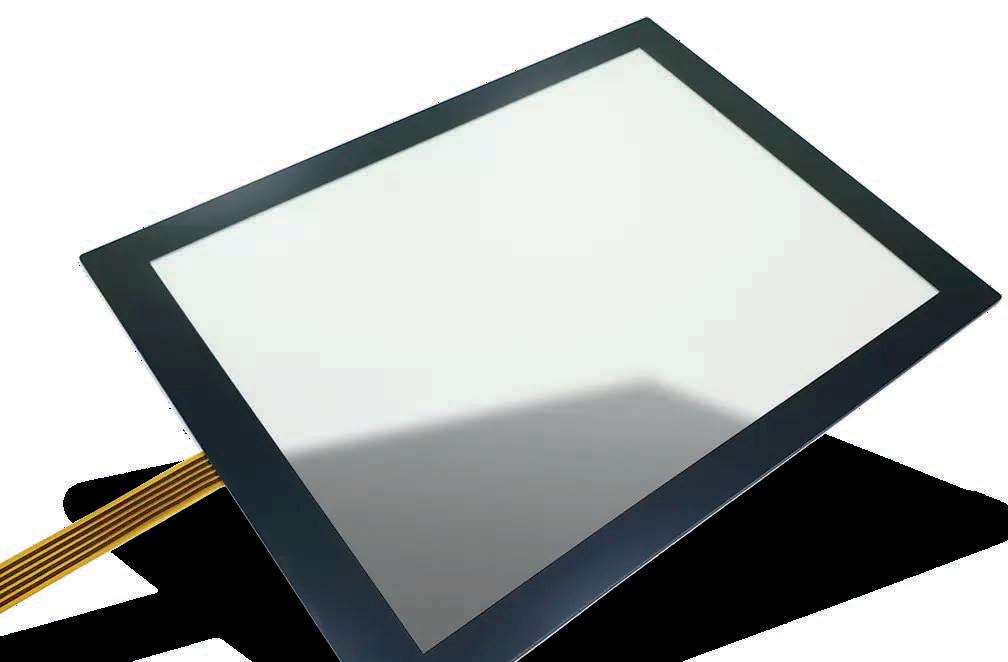
Last month I chose to use a TFT display, based on the simple fact that it was compatible with Arduino UNO shield (Circuit Cellar #409, August, 2024 [1]). That means the display mounts atop an UNO and requires no wiring whatsoever to operate. My micro of choice nowadays is an ESP32. Officially there is no UNO-format ESP32 from Arduino. They do make a NANO format ESP32, but that lacks the Arduino expansion format. Third-party companies such as Wemos offer one, but it's hardly a standard. Using an UNO or MEGA format board with a shield-compatible display board made a lot of sense.
Despite its advantages, a TFT screen cannot emit light on its own, and needs a backlight to generate an image. In this month's column, I add a resistive touchscreen on top of the TFT display
 HOW TFTS AND TOUCHSCREENS WORK
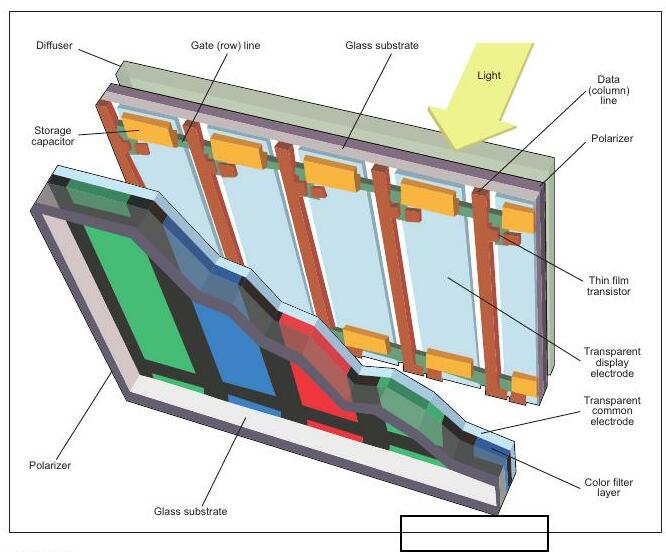
 TFT display: A TFT or "thin-film-transistor" technology display has a sandwich-like structure with liquid crystal material between two glass plates. Referring to Figure 1, you can see the two polarizing and RGB (Red/Green/Blue) color filters, which, combined with two alignment layers, determine the amount of light allowed to pass. An uncharged pixel allows the vertically polarized light to pass unaffected, then it gets blocked by the second horizontal polarizer. When charged, the liquid crystals bend the vertically polarized light 90°, allowing it to pass through the second polarizer. Each pixel in the active RGB matrix is paired with transistors that includes a capacitor to give each sub-pixel the ability to retain its charge. Thus, the TFT layer controls the amount of light allowed to flow through its color filter. The TFT screen, itself, however, can't emit light like an OLED display; it must have a backlight to generate the picture.


Diese Geschichte stammt aus der September 2024-Ausgabe von Circuit Cellar.
Abonnieren Sie Magzter GOLD, um auf Tausende kuratierter Premium-Geschichten und über 9.000 Zeitschriften und Zeitungen zuzugreifen.
Sie sind bereits Abonnent? Anmelden
WEITERE GESCHICHTEN VON Circuit Cellar
Circuit Cellar
Saelig Introduces Economical AIM-TTI ATG1005 5MHz Function Generator
Saelig Co., Inc. announces the AIM-TTI ATG1005 Touchscreen Function Generator, which uses advanced Direct Digital Synthesis (DDS) technology to deliver high-quality, low-distortion Sine, Square, and Pulse waveforms to 5MHz, and triangle waveforms to 500kHz.

1 mins
January 2026
Circuit Cellar
The Future of Edge AI Ultra-Low Power Edge AI
The Case for Intelligence at the Source
3 mins
January 2026

Circuit Cellar
IR Images Come to Your Cellphone
In this article Brian uses a Melexis MLX90640 IR camera module coupled to an ESP32 controller. He streams the image data to a web browser running on a cell phone, tablet, or computer, eliminating the need for a dedicated color LCD. Together, this makes for a very low-price IR camera.
20 mins
January 2026
Circuit Cellar
STMicroelectronics' Intelligent Power Switch Automatically Adjusts to Handle Inrush Current
STMicroelectronics' IPS1050LQ low-side switch IC provides flexible overcurrent protection, including a static mode with fixed, programmable current limit and a dynamic mode that safely handles high inrush current.
1 min
January 2026

Circuit Cellar
Nordic Semiconductor Unveils nRF54LV10A - Breakthrough Low-Voltage Bluetooth LE SOC for Next-Gen Healthcare Wearables
Nordic Semiconductor, a global leader in low-power wireless connectivity solutions, launches the nRF54LV10A SoC, setting a new benchmark for integration, performance, and battery life in the smallest medical devices.
2 mins
January 2026

Circuit Cellar
SemiQ Expands 1200V Gen3 SiC MOSFET Line with Launch of 7.4, 14.5, and 34m2 SOT-227 Modules
SemiQ Inc, a designer, developer, and global supplier of superior silicon carbide (SiC) solutions for ultra-efficient, high- performance, and high-voltage applications, has expanded its family of 1200V Gen3 SiC MOSFETs, launching five SOT- 227 modules that offer RDSon values of 7.4, 14.5, and 34mΩ.
1 min
January 2026

Circuit Cellar
Datasheet: Power Quality Monitoring Watching the Peaks and Valleys
Systems for Monitoring Power Quality for Homes and Industry
2 mins
January 2026

Circuit Cellar
Build a Miniature Greenhouse for Hydroponic and Potted Plants
Automated Monitoring with a Raspberry Pi 4B
10 mins
January 2026

Circuit Cellar
The Pulse of Innovation 600
The Rise of Wearable Technology
18 mins
January 2026

Circuit Cellar
Build a Smart Energy Meter to Track Home Power Use
Using an ESP32 Dev Kit and PZEM-004T Energy Sensor Module
12 mins
January 2026
Listen
Translate
Change font size