
Vuélvete ilimitado con Magzter GOLD
Obtenga acceso ilimitado a más de 9000 revistas, periódicos e historias Premium por solo
Intentar ORO - Gratis
Carpinteria STATE BEACH
Rock&Gem Magazine
|July 2023
Visitors Love it Tar and All!

Got sand in your shoes? At Carpinteria State Beach in California, you may have sand on the inside of your shoes and Miocene-age asphaltum, a natural tar or pitch on the outside if you walk beyond the water's edge. The Carpinteria State Beach is a beautiful and often uncrowded public park about 79 miles north of Los Angeles near Ventura, on the shores of the Pacific. Tar has been oozing and dripping from Miocene-age shale, conglomerates and sandstone bluffs along the Pacific Ocean beachfront since the Pleistocene epoch.
The beach itself is mostly free of asphalt except for the low bluffs along the shore. This park is the only public beach in North America where such a phenomenon is very prominent. While other tar beaches exist in the United States, they are not open to the public. Tar seeps on beaches are uncommon worldwide and there are only five such beaches.
The material oozes out all the time. On land it hardens on cool days, leaving a rubbery black substance that becomes soft again in warm weather.
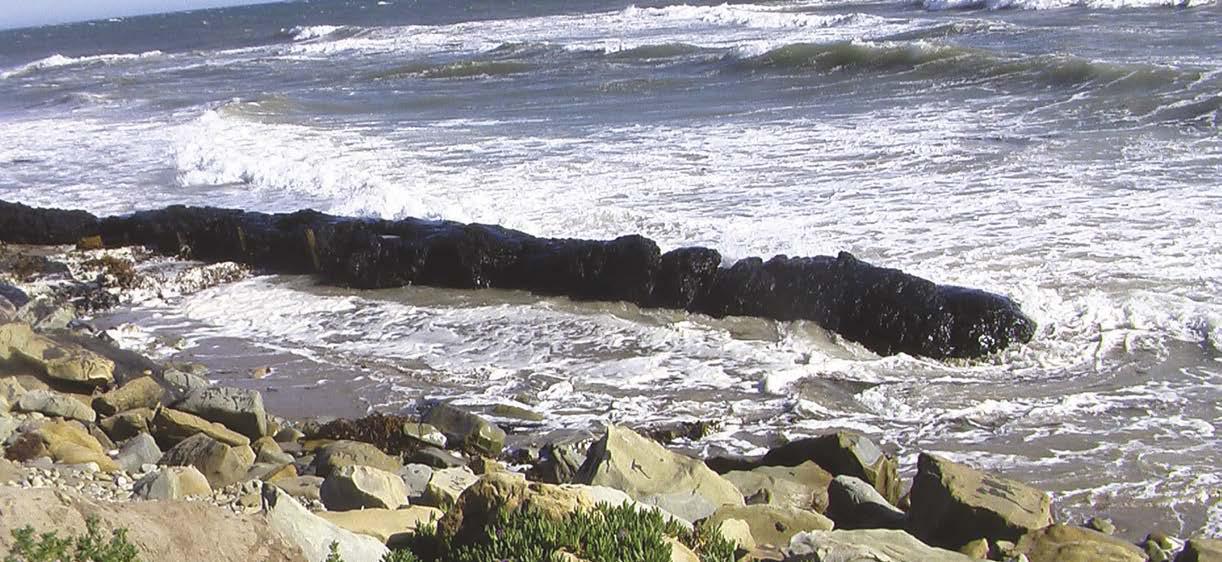
WHY IS THERE SO MUCH PETROLEUM?
The answer lies in plate tectonics. Approximately 35 million years ago a complex of tectonic forces resulting from the interaction of the Pacific Plate, the Farallon Plate and the North American Plate along the San Andreas Fault system began. During the mid-Quaternary, approximately 10 to 15 million years ago, the older trenches along the prehistoric coastline disappeared and transform faults replaced them. A great many things were happening at that time, among them the opening of the Gulf of California (Baja California) because of rifting.

Esta historia es de la edición July 2023 de Rock&Gem Magazine.
Suscríbete a Magzter GOLD para acceder a miles de historias premium seleccionadas y a más de 9000 revistas y periódicos.
¿Ya eres suscriptor? Iniciar sesión
MÁS HISTORIAS DE Rock&Gem Magazine

Rock&Gem Magazine
THIS SUMMER, PICK STONY FLOWERS
Several rock and mineral formations look for all the world like flowers frozen in stone: chrysanthemum stones, flower agate, desert roses and poppy jasper.

6 mins
June 2026
Rock&Gem Magazine
An Ocean's Worth of Water in Earth's Deep Mantle
Water is key to life as we know it. When seeking life beyond our planet, Earth and planetary scientists always seek out planets and moons suspected to harbor liquid water either on the surface or beneath icy crusts.
1 min
June 2026

Rock&Gem Magazine
Hexagonal Diamonds?
Only available from the lab!
1 min
June 2026
Rock&Gem Magazine
While the World Drowns, Greenland Rises
With a mile-thick ice sheet covering 80% of its surface, Greenland accounts for a fifth of current sea level rise as that ice melts on an increasingly warm Earth.
1 min
June 2026
Rock&Gem Magazine
Argyle Diamonds
When the Argyle mine in Western Australia closed in 2020, it marked the end of one of the most remarkable chapters in modern mineral history.
2 mins
June 2026
Rock&Gem Magazine
CHANGING MINERAL MARKETS
As Rock & Gem celebrates its 55th anniversary—no small feat for a print magazine in the digital age—the hottest commodities on today’s mineral markets are lithium, the rare-earth elements and gold.
3 mins
June 2026
Rock&Gem Magazine
Grandpa's Agate Diggings
Finding Moss Agate on the Grande Ronde River
7 mins
June 2026
Rock&Gem Magazine
Does This Fossil Reveal a Whole New Kingdom of Life?
They would have looked strange in the so-called Rhynie chert landscape of the ancient Scottish Highlands 407 million years ago.
1 min
June 2026
Rock&Gem Magazine
From Maps to Satellites: Rockhounding's Tech Evolution
Rock and mineral collecting has come a long way, but the biggest changes have really occurred in just the past few decades.
5 mins
June 2026

Rock&Gem Magazine
BELLY of the DRAGON
A Rockhound's Guide
4 mins
June 2026
Translate
Change font size