
Gå ubegrenset med Magzter GOLD
Få ubegrenset tilgang til over 9000 magasiner, aviser og premiumhistorier for bare
Carpinteria STATE BEACH
Rock&Gem Magazine
|July 2023
Visitors Love it Tar and All!

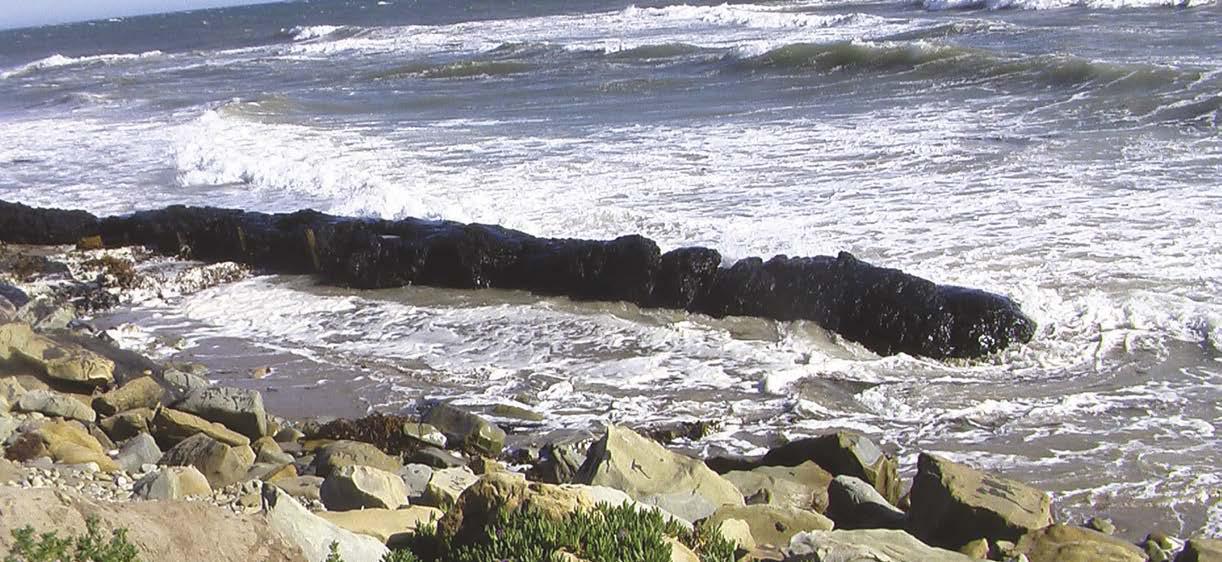
Got sand in your shoes? At Carpinteria State Beach in California, you may have sand on the inside of your shoes and Miocene-age asphaltum, a natural tar or pitch on the outside if you walk beyond the water's edge. The Carpinteria State Beach is a beautiful and often uncrowded public park about 79 miles north of Los Angeles near Ventura, on the shores of the Pacific. Tar has been oozing and dripping from Miocene-age shale, conglomerates and sandstone bluffs along the Pacific Ocean beachfront since the Pleistocene epoch.
The beach itself is mostly free of asphalt except for the low bluffs along the shore. This park is the only public beach in North America where such a phenomenon is very prominent. While other tar beaches exist in the United States, they are not open to the public. Tar seeps on beaches are uncommon worldwide and there are only five such beaches.
The material oozes out all the time. On land it hardens on cool days, leaving a rubbery black substance that becomes soft again in warm weather.
WHY IS THERE SO MUCH PETROLEUM?
The answer lies in plate tectonics. Approximately 35 million years ago a complex of tectonic forces resulting from the interaction of the Pacific Plate, the Farallon Plate and the North American Plate along the San Andreas Fault system began. During the mid-Quaternary, approximately 10 to 15 million years ago, the older trenches along the prehistoric coastline disappeared and transform faults replaced them. A great many things were happening at that time, among them the opening of the Gulf of California (Baja California) because of rifting.

Denne historien er fra July 2023-utgaven av Rock&Gem Magazine.
Abonner på Magzter GOLD for å få tilgang til tusenvis av kuraterte premiumhistorier og over 9000 magasiner og aviser.
Allerede abonnent? Logg på
FLERE HISTORIER FRA Rock&Gem Magazine
Rock&Gem Magazine
A New Amber Locality Fills a Gap
A sandstone quarry in central Ecuador has yielded the first significant deposit of Mesozoic amber from South America.

1 min
January / February 2026
Rock&Gem Magazine
Did "Left-Handed" Fish Leave Water Earlier than Thought?
Fossil evidence suggests that fish (or \"fishapods\") dragged themselves onto land during the middle Devonian Period.
1 min
January / February 2026

Rock&Gem Magazine
"Lab Quakes” Produce Surprising Results
When faults let loose and earthquakes result, the main effect we mortals experience is the violent shaking.
1 min
January / February 2026
Rock&Gem Magazine
This Egg is No Spring Chicken
How to date a dino egg
1 min
January / February 2026
Rock&Gem Magazine
Have we Already Mined the Critical Minerals We Need
Then why are we throwing them away?!
1 min
January / February 2026
Rock&Gem Magazine
One Toxic Worm
A critter that creates & tolerates orpiment!
1 min
January / February 2026
Rock&Gem Magazine
ROCK & GEM FIELD GUIDE: Silver
Silver (Ag) is a native element and one of Earth's most prized precious metals.
2 mins
January / February 2026
Rock&Gem Magazine
DINOSAURS OF THE HELL CREEK MUSEUM
In the Badlands of South Dakota, just outside the small town of Belle Fourche—pronounced “Bell Foosh”—a new attraction has taken shape that every dinosaur enthusiast should see. The Dinosaurs of the Hell Creek Museum is part hands-on exhibit, part science center and part active research lab.
3 mins
January / February 2026
Rock&Gem Magazine
The Lost Twins of Kongsberg
A Silver Story Resurfaced
3 mins
January / February 2026
Rock&Gem Magazine
Switzerland's ICE PALACE
Walk Inside a Glacier at The Top of Europe
7 mins
January / February 2026
Translate
Change font size